
Evelyn in Transit by David Guterson
My Thoughts + Book and Author Information
Don’t miss any of my reviews, click the link here for more.
Evelyn in Transit
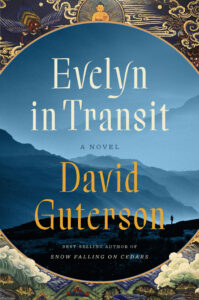 A crystalline short novel about defying expectations, hitting the road, and seeking the right way to live.
Radically open-minded, formidably strong, and unusually clear-eyed about herself and others, Evelyn Bednarz has always been a misfit. She’s easily bored, unsuited to life at school, asks odd questions about faith and time, and sees through conventions others take for granted. Seeking to be true to herself, she hitchhikes across the American West taking odd jobs.
In distant Tibet, another life unfolds as remote from Evelyn’s as can be: the life of a boy named Tsering, raised as a Buddhist monk in the mountains of Tibet, who eventually becomes a high lama.
And yet, their lives are strangely linked―as Evelyn discovers when a trio of Buddhist lamas show up at her door to announce that her five-year-old son Cliff is the seventh reincarnation of the illustrious Norbu Rinpoche, recently deceased. The lamas’ visit sets off a family crisis and a media firestorm over Cliff’s future.
Written in a spare, precise style of extraordinary beauty, full of surprising humor and luminosity, Evelyn in Transit delivers much-needed insight and compassion about humanity’s strivings for transcendence, and what it might mean to “live the right way.”
To purchase Evelyn in Transit, click the following links: Bookshop, Amazon, Barnes & Noble & Books-a-Million
My Thoughts on Evelyn in Transit
Evelyn in Transit is a strange book. “Strange” is neither good nor bad. But strange is not what I expected.
Many readers know David Guterson for his bestselling novel, Snow Falling on Cedars, which starts, “The accused man, Kabuo Miyamoto, sat proudly upright with a rigid grace, his palms placed softly on the defendant’s table—the posture of a man who has detached himself insofar as this is possible at his own trial.” A novel known for its rich language, detailed descriptions, and emotional depths.
Other readers may know The Final Case, a novel that begins, “Awhile back, I stopped writing fiction.” Words that create an immediate connection to the narrator.
Evelyn in Transit sets out very differently. “You climbed onto a stump, and from the stump got hold of a branch, and from that branch caught a higher branch, and after that the branches were so close you could climb until the tree got wispy, and from there you could see the river, tracks, farms, roads, and a line where the earth met the sky.”
Guterson quickly shifts from second person to third person, but continues to keep an emotional distance from the primary characters: Evelyn, a young girl growing up in the sixties in a small town in Indiana, and a Tibetan monk.
But as different as the author voice is in Evelyn in Transit from his other books, Guterson’s interest in why people believe what they believe stays true.
All of Guterson’s novels struggle with big questions. Questions of ethics and morality and, as he says himself about this book, “what should any and all of us do with our time on planet earth, and why?”
This novel flies in the face of conventional fiction in both form and structure. Though Guterson’s poetic nature inhabits the work, it’s in a much less descriptive way. It’s as if he has discovered that paring description down to its simplest is also the most pure.
We are introduced to Tsering this way. “Tsering was playing by himself in a cold wind. Behind the storehouse, near the road, sat a mound of yak hides. They were like things in a dream, real and unreal. The hair was still on then, including the long hair, the belly hair. the skirt.”
In these opening scenes of Evelyn and Tsering, we discover characters realizing an important aspect of the human experience. That we are unique, alive, and separate from every other living creature. It is at this moment in a person’s life, that they must then determine what they owe to others, what expectations they must follow, and what path will best lead them to an authentic life—whether that suits the anticipated narrative or not.
Somewhere, in the travels of Evelyn and Tsering, Guterson provides these characters, and readers, their answers to those questions. And though the track leading readers through the novel may wander, that may be the point. Life is neither predetermined nor completely free. We are, each of us, a combination of our history, biology, upbringing, and some unnamable individual spirit that rests in every living thing.
Evelyn in Transit is a strange book, but we live in strange times. Perhaps this question of what should we do with our time here on earth, is something we should all be asking ourselves with a little more frequency. What do we owe to others? What do we owe to ourselves? And what peace can we find as we navigate the path in front of us, in a way that does no harm.
Buddhism holds in part, the concept that our actions have consequences, and that by practicing compassion we can learn to let go of suffering. Two things we could all use a little more of in this life.
If you read Evelyn in Transit, and I hope you will, I’d love to hear your thoughts about the story. Reach out to me anytime and let me know.
Evelyn in Transit Author David Guterson

David Guterson is the author of 12 books, including the novel Snow Falling on Cedars, winner of the PEN/Faulkner Award and of the American Booksellers Association Book of the Year Award.
His writing has been celebrated for its atmospheric intensity, narrative drive, and probing exploration of fundamental human themes—love, death, meaning, and morality among them. Guterson’s body of work includes 6 novels, 2 story collections, 2 works of non-fiction, and 2 books of poetry. He was born in Washington State and still lives there.
To learn more about David, click any of the following links: Instagram, Facebook, and Website
Elena Hartwell | Elena Taylor

Header image from Pixabay