Too Many Bridges, debut crime novel by Bill Gormley
Debut Author Interview + Book & Author Info + Author Pet Corner!
Don’t miss any Debut Author Interviews! Click the link here for more.
Too Many Bridges
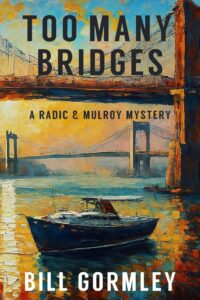
An eyewitness to a murder calls the Pittsburgh police from one of the city’s 446 bridges, then disappears. To solve the case, the police must find the bridge. But where to start?
Detective Branko Radic and Officer Kathleen Mulroy seek help from a nun, a professor, a mechanic, and a tattoo artist. They learn of a family feud, a business in trouble, some sketchy Harry Potter merchandise, and a missing young woman. If only they can find the right bridge, they might be able to put it all together.
But sometimes, a case is like a funhouse mirror at an amusement park. You have to adjust to the distortions in order to perceive the truth.
To purchase Too Many Bridges, click on any of the following links: Amazon, Barnes and Noble & Riverstone Books
Too Many Bridges — Author Interview
Too Many Bridges is set in Pittsburgh, where police must identify which bridge is connected to an anonymous eyewitness reporting a murder. With 446 bridges, that’s a big task! What prompted that concept to launch your story?
In cooking up my plot, I was inspired by a real-life situation—a bridge that sang, though only for a while.
The bridge, surprisingly, was San Francisco’s beloved Golden Gate Bridge. After some much-needed repair work on the railing, the bridge started producing scary music on windy nights. It unnerved the residents, who demanded a do-over and got it.
This got me thinking: Do bridges have distinctive audio signatures? And what if police got a call from someone reporting a murder but all they had to go on was the “sound” of the bridge? To locate the anonymous eyewitness, they must first find the bridge. Not easy in a city like Pittsburgh with 446 bridges! I thought that would be a fun premise to work with.
Too Many Bridges centers on the police team of Detective Branko Radic and Officer Kathleen Mulroy. Tell us about those characters and how they work together.
Radic, 36, is a Croatian-American police detective, who has a reputation for solving difficult murder cases.
Although he doesn’t advertise it widely, his older sister was murdered while serving in the Peace Corps. This motivated him to become a police officer and continues to motivate him today. Mulroy, 30, is an Irish-American police patrol officer, who is on track to become a detective.
Radic likes her and respects her and is happy to team up with her. They work well together, partly because they think differently. Radic is evidence-focused, while Mulroy is more intuitive. It’s a winning combination.
Too Many Bridges has been compared to Ed McBain, which is pretty heady stuff. What writers have been inspirational to you? Are there any that you feel impacted your writing, in terms of style, content, or characters?
I’m no Ed McBain, but it’s an honor to be linked to him, even in an aspirational way.
I love the ensemble cast of characters in his 87th precinct novels: Steve Carella, Meyer Meyer, Bert Kling, “Fat Ollie” Weeks. Very different personalities, but absolutely determined to solve difficult cases. In conjuring up a man/woman detective team, I owe a debt to Elizabeth George, whose pairing of Thomas Lynley and Barbara Havers shows us that police officers with different temperaments, from different social classes, sometimes make great partners.
Beyond that, I love quirky, funny characters. Like ones you find in books by Elmore Leonard, Ellie Griffiths, Janet Evanovich, Richard Osman. If I can smuggle two or three of them into my book, I’m happy to do so.
In a past career, you were a Professor of Public Policy and Government at Georgetown University and have written a lot of nonfiction. How does that experience impact your fiction? Did it help, hinder, or something in between to be experienced in another category of writing?
The big advantage of having written social science books and articles is that it anchors you to the truth.
When writing mysteries, I have the same urge to be truthful and accurate that I did when I was discussing early childhood education policy, bureaucratic politics, federalism and intergovernmental relations, and other subjects.
To put it a different way, I’m accustomed to doing research. So, I’ve turned to experts, including cops, former cops, emergency services personnel, transportation engineers, intellectual property lawyers, and others to get the facts straight. I hope that makes my mysteries more authentic.
In addition to your debut mystery, which appeared in 2024, you started up a podcast this year. Tell us more about the podcast and why people might want to tune in.
Many mystery writers will tell you that they’re constantly trying to learn more about policing and police practices. Profs on Cops is aimed at those writers, including myself.
Every month or so, I interview a criminologist who has done empirical research on policing. How widespread are body-worn cameras and how do BWCs affect police and citizen behavior? What goes through a police officer’s head when thrust into a dangerous situation where lethal force may be required?
Next up: Can we do a better job of training police officers? Every episode is just under 30 minutes. The guests speak in digestible sound bites. I prod them a bit when they say something fuzzy or provocative. It’s fun. People should check us out! (Apple or Spotify).
When you’re not reading and writing mysteries, we can find you playing jazz piano. Tell us why that musical style speaks to you. Are you a solo player? Or do you like to play with other musicians?
To me, jazz is the quintessential American music. We invented it, and we should enjoy it.
I play at least once a week with a group of amateur jazz musicians in the DC metro area. It’s exhilarating! After we run through a jazz standard once in a traditional way, each of us improvises, kind of like a trapeze artist performing without a net. What’s exciting about this is that you don’t know where you are going until you actually start playing and something new emerges.
The fear of failure is quite real. But when it works, it’s magical. The relevance of this to my fiction writing is that it makes me more of a “pantser” and less of a “plotter” when I write a mystery. Instead of forcing reluctant characters to go in a particular direction, I often put them into a difficult situation and see what happens. I’m less the master puppeteer than an eavesdropper or an eyewitness.
What are you working on now?
My next book, The Silent Trumpet, is pretty far along.
Radic and Mulroy are back and Mulroy is now a full-fledged detective. The book begins when a talented Black jazz trumpeter, Larry Mabry, is roughed up by a narcotics cop just outside the jazz club where he is performing. Larry’s brother Gary tries to secure his release. Gary has been Pittsburgh’s leading drug dealer for several years but is trying to turn over a new leaf.
Things get very messy very fast. Race, drugs, and politics are a volatile mixture. There’s more conflict in this book than in my debut mystery, both within the police department and between the police and the community. So far, I’m enjoying the change of pace. As always, I am eager to see what Radic and Mulroy do next!
Words of Wisdom for aspiring writers:
Take criticism well. It’s better to be criticized before your book appears than afterwards!
Great advice! Congrats again on your debut.

Author Pet Corner!
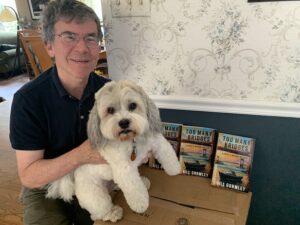
Regrets? Not Really . . .
It’s simple math, if you buy a book, I get more treats!
Auggies is a Havanese.
After a heart-to-heart conversation, he is now on board with “the mystery thing.”
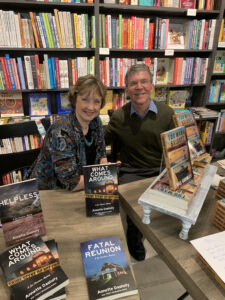
Bill Gormley —Author of Too Many Bridges
Bill Gormley is a recently retired Georgetown University Professor of Public Policy. For 33 years, he taught courses on public policy and bureaucratic politics. His first mystery, Too Many Bridges, a police procedural set in Pittsburgh, was published by Level Best Books in August 2024.
His podcast, PROFS ON COPS, featuring interviews with criminologists about research on policing, is available through Apple and Spotify.
For more information, please see: www.billgormley.com
To learn more about Bill, click on any of the following links: Website, Twitter & Facebook
Elena Hartwell/Elena Taylor
Header image from Pixabay