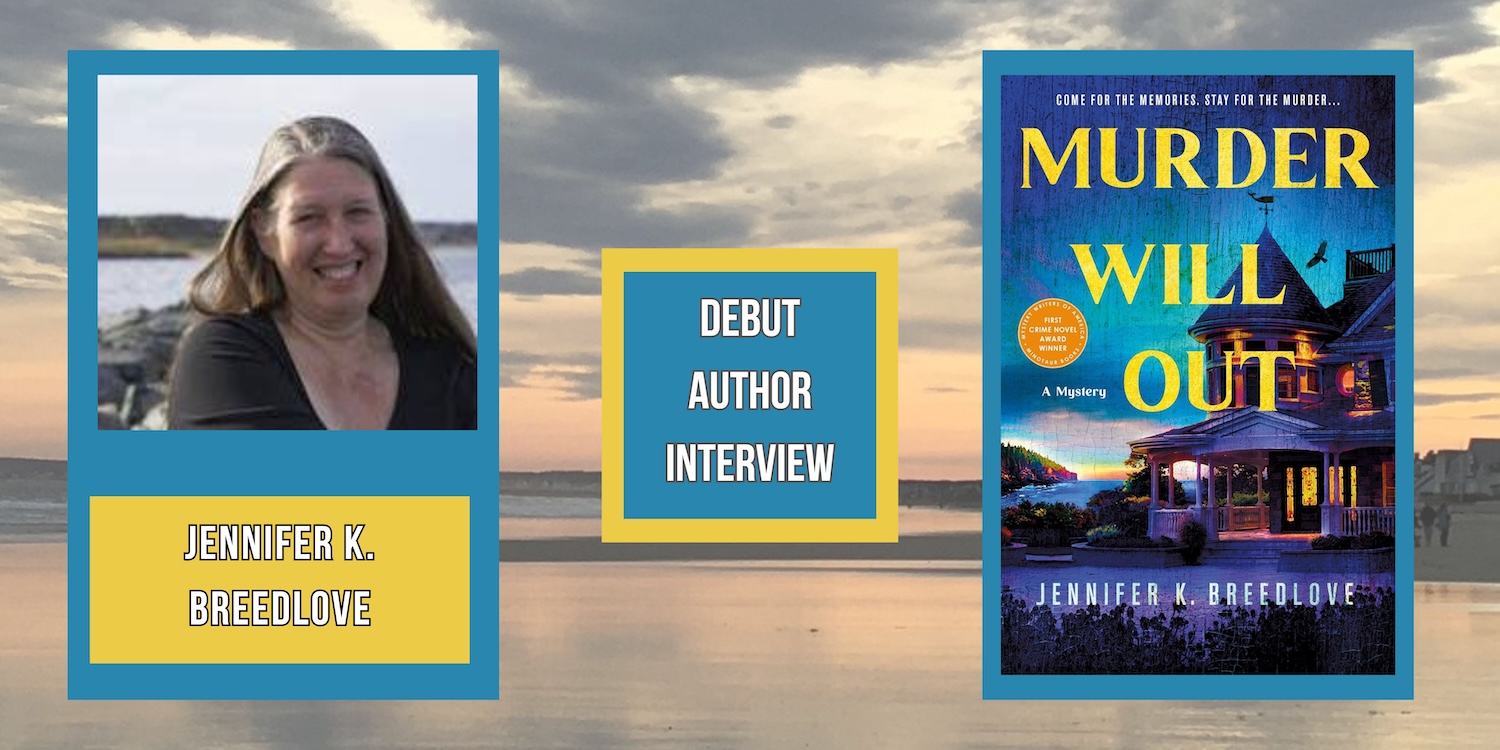
Murder Will Out by Jennifer K. Breedlove
Author Interview + Book & Author Info + Author Pet Corner!
Don’t miss any ITW Debut Author interviews! Click the link here.
Murder Will Out
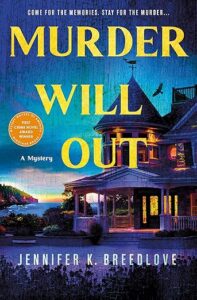 Minotaur Books/Mystery Writers of America First Crime Novel Award winner Jennifer K. Breedlove brings coastal Maine to life in Murder Will Out, a lighter, modern gothic mystery that’s as atmospheric as it is heart-warming.
Come for the memories. Stay for the murder…
Little North Island, off the coast of Maine, is so beautiful it could be a postcard. Organist Willow Stone cherishes her memories of childhood summers spent on the island with her godmother Sue… even though her visits ended abruptly, and she hasn’t seen or heard from her godmother in over fifteen years. Until a letter from Sue―and word of Sue’s death―brings Willow back to the picturesque island.
The islanders rarely mention Sue without also bringing up Cameron House, and the controversy around Sue’s unexpected inheritance of the sprawling mansion. When Willow overhears someone threatening the next heir to the property, she starts to question whether Sue’s death was really an accident, and can’t help but wonder whether someone on this sleepy island is willing to stop at nothing―even murder―to claim Cameron House for their own.
Through Willow’s eyes, as well as those of others on the island, a mystery unfolds that keeps drawing Willow back to Cameron House and the very real ghosts that walk its corridors.
To purchase Murder Will Out, click the link Here.
Murder Will Out Interview with Author Jennifer K. Breedlove
Murder Will Out is set on Little North Island, off the coast of Maine. What made you decide on that location for your debut?
Our family travelled to coastal Maine every summer while I was a kid; after we grew up, my parents retired up there—they built a log home and lived in it nearly year-round. My mom is a ceramic artist, and she now sells her work from a pottery shop on Little Cranberry Island; my dad for many years was active in the historical society around Somesville and Southwest Harbor, writing articles and essays for them and being a docent for local history events. The history up there is fascinating and so layered, with so many good stories—and lots of haunted buildings, according to local lore!
Little North Island itself is fictional, but it represents an amalgamation of “real” locations I have visited and loved all my life. Besides, islands of all kinds, especially ones with big enigmatic houses (I’m thinking of your The Haunting of Emily Grace) are wonderful places to set any kind of mystery-thriller. They have that built-in isolation factor that keeps you cut off from the rest of the world; at the same time, they can also be home to a close-knit local community.
In Murder Will Out, I like to play with both dynamics: the creepy isolation factor gives the book its Gothic vibe, while the village community offers elements of a “cozier” type mystery.
Thank you for thinking of my book!
Murder Will Out centers on Willow Stone. Tell us something about Willow that might surprise readers:
Willow first appears on the page as a young woman who feels isolated and out of sync with her world and the people in it. But she has this brilliant mind and memory, and as a musician, she’s able to mobilize her ear-brain connection to see patterns and links others might miss.
For me, she’s the embodiment of the person who might be underestimated or dismissed as passive or weak-willed, when in reality they are taking in everything and just waiting for the right moment. When that moment comes for Willow, I think she surprises not only readers but herself as well.
Tell us about your road to publication with Murder Will Out:
You know how when we write our first book we think, “Hey, wouldn’t it be cool if I entered a contest and won a publishing contract?” and then we laugh because of course we know it couldn’t possibly happen? In my case, it really did, and I’m still pinching myself.
Early in my querying journey, I had entered a few competitions, including the St. Martin’s Minotaur/Mystery Writers of America First Crime novel contest; I then promptly forgot about them, figuring nothing would come of it. Months upon months went by, and I continued my work of polishing and honing the manuscript, but the rejections and non-responses kept piling up; I began to accept that maybe this book wasn’t going to go anywhere, and I started turning my attention to new projects.
Then one day in early April, driving home from Minnesota in a blizzard (because of course it would be snowing in Minnesota in April), I got the call from my editor at Minotaur Books telling me that my book had been chosen as this year’s Minotaur/MWA First Crime Novel winner, the prize for which is a publishing contract. The process from then to now took a while, but—here we are!
Murder Will Out threads the paranormal through suspense. What are your beliefs about ghosts and hauntings and all things supernatural?
People ask me this fairly often, and I don’t really have a satisfying answer!
I do hold the belief that most of what we consider to be “supernatural” is probably not supernatural at all, but simply a part of the “natural” world that we don’t yet understand. For all we’ve learned about the universe and reality, we still have only the smallest understanding of the nature of human consciousness, where it comes from, and what happens to it when we die. So honestly … I don’t know exactly what I believe about ghosts and hauntings. But I am intensely curious, and I love exploring the what-ifs.
You are also a professional musician, conductor, and composer. How does music inform your writing?
I’ve spent thousands of hours in music practice rooms: vocal exercises, playing scales, dissecting certain passages over and over again, or sometimes learning music I will never perform—not a single note is “extra” or “wasted,” it’s just part of the process. I feel the same way about writing.
Especially in the drafting phase, I don’t worry about whether I’m overwriting, or if this chapter might or might not go into the final draft, or if the action stops for six pages of info-dumping about the floor plan of a certain haunted mansion. Of course, I had to worry about it later—those six pages (it might have been more) would be intensely dull if I left them in the manuscript. Still, I had to write them if I was to discover, not just how the mansion is laid out, but how it feels to walk from one room or floor to the next. I wrote scenes from three or four different points of view before settling into the one that told the story best. There are so many words I wrote that will never see the light of day, and that’s okay.
When I hear writers talk about “killing your darlings” as though cutting a chapter here or a character there, or this description, or that nice bit of dialogue, is somehow a tragic thing, I want to hug them and tell them it’s okay, no one’s killing anyone here (unless it’s part of your crime novel, in which case, go for it). For one thing, unlike all those unheard-by-anyone-but-me practice room sessions, none of our words need to be consigned to oblivion—we can tuck them into a folder somewhere in case we might need them again. But more to the point, all that deleted backstory, all the unnecessary exposition, is part of the path to the final polished book—at least it is for me.
This is fantastic advice!
Words of Wisdom for Aspiring Writers:
I don’t know how many novels I’ve started over the years that never went anywhere; I usually put them aside partway through because I got lost in my own plotting or didn’t know where the story was heading. For me the key that unlocked the ability to finish a novel was the discovery of a story structure concept I could work with. There are tons of them out there—Three-act, four act, Save the Cat, K.M. Weiland’s Helping Writers Become Authors materials, StoryGrid, Story Engineering, and Jane Kalmes’s amazing mystery plotting resources, just to name a few.
The one that lit up my storytelling brain was Pages and Platforms’ Story Path. Still, everyone’s mind works a little differently, and not every system will click with every writer; my main advice, especially for anyone who has trouble finishing a novel or making a story cohere the way they want it to, is to keep studying till you find the story structure concept that works for you.
Story structure is the skeleton of your novel, the scaffolding, the tent poles, whatever metaphor you like—but it’s the thing that governs whether the edifice you’re building will stand up or collapse under its own weight. I envy writers who can dive into a story without thinking about this and come out with a working narrative; for the rest of us mortals, my advice would be to study as many of these structural systems as you can and see what works.
What are you working on now?
I’m deep in another Little North Island mystery right now, and I have various other plots cooking away in my brain. I can’t say much without giving spoilers for how this first book ends, but there are a lot of stories left to tell about Cameron House, its ghosts, and the people we’ve met on the island. Everyone has secrets, and even I don’t know all of them yet.
Author Pet Corner!

This is Layla, our ten-year-old rescue dachshund.
She runs the household, adores belly rubs, and excels at her job of keeping our laps warm during cold Chicago winters.
Jasper, age 2, is our newest household member; we like to say we got Layla a puppy when she got lonely after our other wiener dog passed away last year at age 17.
He’s full of energy and wicked smart; he’s hearing impaired but is learning sign language faster than his humans, and he follows Jennifer around like a shadow.
Murder Will Out Author Jennifer K. Breedlove
Jennifer K. Breedlove holds degrees in piano, choral conducting, and theology; she is on the music faculty at Loyola University in Chicago and serves as an assistant conductor for the Chicago Symphony Orchestra Chorus. Jennifer has worked as a church musician, educator, and editor and is a prolific composer of choral music; her compositions, as well as her nonfiction books and articles, are available through several major publishers.
A frequent visitor to Downeast Maine since childhood, she has an enduring affection for the wild beauty of the coastal islands and the warmth of the people who make their homes there.
Her debut novel, Murder Will Out, won the Minotaur Books/Mystery Writers of America First Crime Novel Award.
She lives in the western suburbs of Chicago with her husband, two dogs, and two kids currently attending college. Demonstrating once again the cliché about apples and trees, her son is a music major, and her daughter plans to be a writer.
To learn more about Jennifer, click on any of the following links: Website, Instagram.
Elena Hartwell/Elena Taylor
Header image from Pixabay