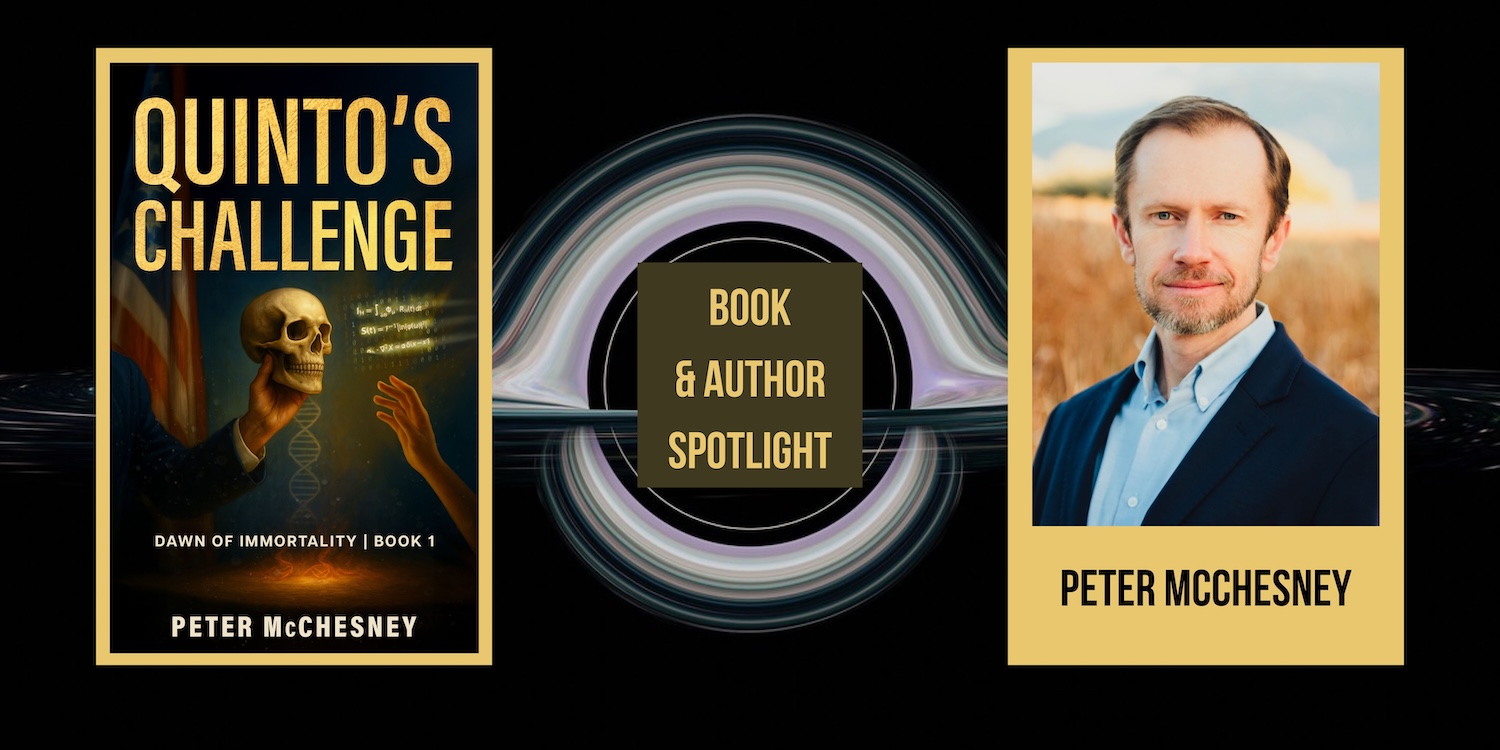
Quinto’s Challenge by Peter McChesney
Author Spotlight + Book & Author Info + Author Pet Corner + an Excerpt!
Don’t miss any new books! Click the link here.
Quinto’s Challenge
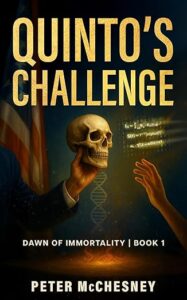
To purchase your copy of Quinto’s Challenge, click the following link: Amazon.
Praise for Quinto’s Challenge
“Lovers of science fiction novels with a touch of political intrigue and suspense will find Quinto’s Challenge by Peter McChesney an enthralling read.” — Readers’ Favorite
“A compelling SF saga that focuses on the humanity behind big tech.” — Kirkus Reviews
“In Peter McChesney’s sweeping science fiction novel Quinto’s Challenge, a brilliant young outsider’s theories change the trajectories of physics and philosophy.” — Foreword Clarion Reviews
Read an excerpt of Quinto’s Challenge:
By Peter McChesney
This excerpt is Chapter 2 of Quinto’s Challenge by Peter McChesney. A brief opening chapter precedes it, introducing Deeley Carr, her new job at the Center for Advanced Particle Research (CAPR), and the world she inhabits near the end of the 21st century.
In Chapter 2, Deeley watches the historic speech by former President Vince Quinto, an address that challenges the nation to achieve something most believe impossible. It’s a moment that ignites the journey ahead, one far greater than Deeley ever imagined, for herself or for humanity.
Chapter 2
American Prophet
“Our new theoretical physicist, Deeley Carr, arrived here in Particle City today. She has no Ph.D., so Bergstrom strongly advised against hiring her. But the theories she published were undoubtedly the product of a mind that understands quantum physics better than most, and I will take that over a credential any day. It is going to be very interesting to see how she turns out.”
— AI Journal Excerpt: James Meitner, August 25, 2097
Monday, August 26th dawned bright but cloudy over Particle City. It was Deeley’s official first day of employment at CAPR, and she rose at dawn, energized and ready to begin her new journey.
After sliding in her SecondSight lenses, she retrieved the AI journal entry from the previous day. A write-up, paired with three-dimensional images and video clips, memorialized her arrival in Particle City. It made her smile.
While SecondSight was a classical device, its AI journals were quantum-encrypted in the cloud—accessible only by the owner unless they granted explicit permission or scheduled decryption, often posthumously. The encryption was so robust that even employees on top-secret government projects could use the AI to securely record general references to their work.
***
With time to spare before Charity’s arrival, Deeley decided that a fitting way to begin her inaugural day of employment was by watching Vince Quinto’s famous Special Address to a Joint Session of Congress—the speech that had made everything in this new chapter of her life possible.
She settled onto her living room couch and, within SecondSight, loaded the full speech in virtual reality. SecondSight blocked out all other light sources, making it feel as if she’d been transported back in time to the House Chamber to witness the event in person. She looked around the virtually rendered chamber, every feature faithfully preserved in stunning detail.
Although Deeley had seen Quinto’s address before, her new employment at CAPR gave it new meaning. Briefly overlayed on the VR as an introduction was an excerpt from a journal entry Quinto had written on the evening of his inauguration, roughly four months before the address:
“The power of the presidency bestowed on me to change the country, to change the world, will be fleeting. While I hold this power, should I be bold and show the world my vision of what could be, asking them to follow? Or should I be safe and regret what could have been? It is clear to me that there is only one of these paths that I can follow, even if it comes at great political risk.”
Those words gave Deeley chills. With a smile, she immersed herself in the virtual environment:
It was May 25, 2061. As was customary for a Special Address, the House Chamber brimmed with members of Congress, Cabinet officials, Supreme Court Justices, the Diplomatic Corps, the Joint Chiefs, and an array of distinguished guests. What differed was the protocol: more akin to a State of the Union address than a typical Joint Session. But most significantly, the global circumstances under which the address was taking place were unprecedented. A new world order had dawned, and the era of American hegemony was over.
The global balance of economic, military, and political power had decisively shifted, with China rising as the world’s dominant superpower, a change driven by the leadership of a new Chinese president, whose ambition and strategic brilliance reshaped the global landscape. The Millennials, Generation Z, and Generation Alpha—who held power in Washington and were assembled in the House Chamber—were slowly and uncomfortably coming to terms with this new reality, and it showed on their faces.
With a thought, Deeley teleported herself through the virtual House Chamber to glimpse Vince Quinto standing just beyond the threshold, waiting to enter. As the President came into view, an expression of admiration softened her face. She was always struck by how calm Quinto remained just before delivering his first address to Congress during a time of profound international change. Almost any other president would have felt immense pressure to deliver an address that was at least moderately well received under such circumstances. But Quinto was at ease. He saw the humbling of America as an opportunity for something greater—and he intended to seize it in a most dramatic way.
Quinto was clad in a navy blue suit complemented by a regal purple tie, his hands resting just below his waist, fingers interlocked. He was moments away from delivering the most audacious Special Address to a Joint Session of Congress in American history.
In his memoir, the 53rd President later explained that at this moment, he was contemplating the progress quantum physics had made in his lifetime. It was a thought not typically associated with Special Addresses, and one especially out of step with the subdued national mood.
Her face alight with excitement, Deeley teleported back into the House Chamber to hear the House Sergeant at Arms.
“Mr. Speaker, the President of the United States!”
Vince Quinto entered the chamber to customary applause. His presence lifted the energy in the room, and the applause, in turn, energized him. He took time to shake hands and briefly exchange words with those gathered along the aisle as he slowly made his way to the podium.
The timing of Quinto’s Special Address—exactly 100 years to the day after JFK’s speech challenging America to land a man on the moon and return him safely to Earth—suggested to those present that this occasion carried a unique purpose. An expectation for something meaningful hung in the air.
At 65 years old—a physician by training—with an olive complexion, brown eyes, and dark hair just beginning to gray at the temples, Quinto looked every bit like a seasoned politician.
While he was a capable executive, he was more philosophical than most presidents, and more passionate about science than about serving as the central cog in the Washington machine.
After navigating his path to the podium and exchanging handshakes with the Vice President and Speaker of the House, Quinto turned toward the audience, offering a nod of gratitude to all assembled.
Delighted to witness the history about to unfold, Deeley repositioned herself just a few yards from the podium, seated on a virtual rendition of her couch floating in the air between Quinto and the first row.
With a firm strike of the gavel, the Speaker of the House announced, “Members of Congress, I have the high privilege and distinct honor of introducing to you the President of the United States.”
More applause.
Deeley clapped along enthusiastically.
Quinto thanked the audience, and those assembled took their seats.
As he would later reveal in his memoir, his political staff were fidgeting with anxiety back at the White House as he approached the podium. Not only was there enormous pressure on the new President to address the nation effectively at a time of low morale, but nearly every sentence of the speech prepared by his staff—crafted with the help of advanced AI leveraging extensive polling data—had been rejected in favor of a short, radical address written entirely by Quinto himself. His staff had warned him that not only the length, but especially the content, was not just politically risky but borderline delusional.
Quinto, however, was not concerned.
Gripping the podium with both hands, President Quinto—like a preacher filled with fire in his soul—felt the mantle fall upon him. He began his remarks by quickly, though indirectly, acknowledging the Chinese elephant in the room:
“Mr. Speaker, Mr. Vice President, members of Congress, my fellow Americans. Out of all the nations on Earth, this Union played the most crucial role in modernizing the world we enjoy today. Whether building the framework upon which information flows instantly around the globe, or undertaking the research and development that has given rise to the world’s most advanced AI, or pioneering medical science that sustains healthy living to unprecedented levels in human history, each nation on Earth has benefited in innumerable ways from the contributions of the United States of America.”
All in the chamber rose with applause.
“As an American, I am proud of my nation’s accomplishments. As a human, I rejoice that many around the world today—especially those who once lived in poverty or without secured rights—now prosper within their own nations on a scale undreamed of by their forebears of previous centuries.”
About half the chamber rose in applause.
“I can only hope that such levels of prosperity continue to grow and never fade. That others have lifted themselves up is not something that should distract from the greatness of this nation. There is no reason to feel low because others have gone high. Yes, we have entered a new global order, and there are uncharted waters to navigate. But nothing—I repeat, nothing—can be understood except in context.
“For example, the battles George Washington lost during the Revolutionary War outnumbered those he won. But time revealed that America would win the war. Those who sincerely supported the Soviet experiment—mandating equality for all—did not yet have the context of the horrors such a system would eventually bring. And when Einstein discovered that E=MC², he had no idea how it would revolutionize humanity—for better and for worse.”
Deeley nodded.
“Though our role in the world has changed, I firmly believe that the United States’ greatest contributions to humanity are still ahead of us. I also see, in this moment of transition, an opportunity to unite around a common purpose—to rally around a goal of such value to all nations that thoughts of hegemony will become irrelevant.”
Most of the chamber applauded.
“Think, just for a moment, about the problems we humans have solved through the power of collaboration—by sharing a vision, pooling our resources, and working together as one. We found a way to cure paraplegia and quadriplegia. Alzheimer’s is a thing of the past. We’ve traveled to Mars and back, answering questions about the origins of the universe—questions that, just decades ago, were thought to be eternal mysteries.
“All of these—and more—were once considered impossible. Yet these so-called impossible problems were solved. And they were solved because many came together to work as one. Whether through entrepreneurial activity, legislative action, or contributing in some other way—directly or indirectly—human unity has brought forth wonders!”
Deeley, on high emotions for her first day as an employee of CAPR and inspired by Quinto’s words, felt her eyes begin to water.
“To those assembled in this chamber—and to all listening to my words—consider not only what human unity has accomplished, but what we are still achieving. We’ve reached 100% energy sustainability and built a net-zero emissions economy. Atmospheric cleansing technologies helped us avert the climate crisis. Economically viable fusion power has been achieved and is now in early implementation. Once-extinct animals again walk the Earth … and we’ve developed advanced means of communication with animals in general.
“We edit the genomes of our unborn to eliminate disease before it begins. We are the generation that began curing cancer. We’ve developed techniques to revive the brain-dead and extend human life beyond any age previously experienced. And this medical revolution continues to accelerate—curing diseases that, just decades ago, were fatal.
“All of these problems seemed unsolvable to the generations who faced them. But through collaboration—by working together as one—science led us to solutions, and life has been greatly enriched in due course. If this is what we’ve achieved today, imagine what we’ll achieve tomorrow—10 years from now, 50 years from now!
“The question at hand is this: Is there any problem we cannot solve through collaboration?”
More applause.
In his memoir, Quinto noted that at this moment in his speech, his thoughts briefly turned to his first wife, who had been killed in a tragic accident early in their marriage.
“This very day marks the 100th anniversary of when President John F. Kennedy stood in this very spot and challenged America to land a man on the moon and return him safely to Earth before the decade was out. That challenge was issued during the nuclear arms race—a time of tremendous risk and turmoil. Yet from that maelstrom, America rose to meet it.
“Now imagine traveling back in time to speak with Da Vinci, Hypatia, Socrates, or any great thinker or explorer from the past. Imagine standing with them, pointing to the moon, and telling them that one day humanity would find a way to fly there—and walk there. It wouldn’t be surprising if they refused to believe us. But just imagine what they would have thought … imagine what they would have felt … if they did believe us. A revelation of such human potential would be seen as a miracle among miracles.”
Deeley smiled with admiration, completely aligned with Quinto’s way of thinking.
“By achieving what humanity once thought impossible—walking on the moon—America inspired the world and opened the door to the heavens, where many secrets of the universe would be uncovered to bless the lives of billions yet unborn. Of this great feat, President Kennedy proclaimed: ‘We choose to go to the moon in this decade and do the other things, not because they are easy, but because they are hard.’
“My fellow Americans, the time has once again come to focus ourselves as a nation on a great cause—to dedicate our efforts and pool our resources to achieve a goal of such significance that humanity will be positively impacted forevermore. While we still yearn for America to inspire and lead as it once did, we have forgotten how far we must reach to truly inspire all humanity. But I say to you this day: we have an opportunity to reach far once again.”
Shivers ran up and down Deeley’s spine.
“And so, we come to a critical question: What is more miraculous—that after eons of time, simple atoms could arrange themselves into complex, intelligent beings capable of thought, ideas, art, compassion, great civilization, love, and joy; or that those intelligent beings might one day use the power of science to raise their kin from the grave, returning them to full life and health?
“If you believe, as I do, that the greater of these miracles is the former—that life arose in the first place—then I stand before you to assure you that the latter, the miracle of resurrection, is not only possible, but inevitable in this great game of life.”
The House Chamber fell silent. The usual pattern of a Special Address had been thoroughly interrupted. All gave their full and undivided attention as Quinto reached inside the podium and withdrew an object he’d had placed there in advance: a round item, covered by a purple cloth. He set it atop the bench to his left, then pulled away the cloth—revealing a human skull.
Gasps rippled through the chamber. Soft murmurs followed. Quinto lifted the skull in his left hand, holding it just above his face, its gaze aligned with his own. For a moment, he stared into it—visualizing the words he would say next.
Deeley was exceptionally excited.
“Just as we might share our accomplishment of journeying to the moon with great thinkers from antiquity, I believe that if our descendants could visit us from the future—stand beside us and hold a human skull in their hand—they would say that one day, humanity finds a way to bring the original owner of that skull back from the grave—with their memories intact, their personality restored, and their body returned to full health.
“I believe that one day, a collaboration between advanced AI and gifted scientists will unlock the secret that makes life after death possible.”
Silence.
“Yes, I’ve pondered this topic for a long, long time. And I genuinely believe—with all my heart—that human resurrection lies fully within the realm of science, and that it is simply a matter of time and effort until it becomes reality.”
The chamber remained immobile. The silence was so profound that Quinto could distinctly hear his own breathing.
“Imagine what this means in the greater context. If resurrection can be achieved in our world, then no doubt it has already been accomplished elsewhere in the cosmos—by older, more advanced civilizations, possibly eons ago. Perhaps humanity is being watched even now by immortal beings among the stars, waiting to make their vast continent of worlds known to our small island, once we are ready. When one truly grasps the realities of what I’m speaking about, the possibilities are phenomenal!”
The chamber remained as silent as night. In that moment, Quinto’s thoughts again drifted to his first wife. He gently placed the skull down and proclaimed:
“My fellow Americans, just as President Kennedy challenged the uncertain nation of his day to do what was hitherto unthinkable—to land a man on the moon and return him safely to the Earth—I firmly believe that we should commit ourselves, before this century is out, to discover the secrets of physics and genetics necessary to raise a human from the grave and thereby conquer death once and for all!”
Deeley’s eyes welled with tears, though they didn’t overflow—she knew a disruption was about to come.
President Quinto let the silence linger. Slowly, several members of Congress stood, visibly flabbergasted. Yet they clapped. Slower still, others rose and joined in the applause, until nearly the entire chamber erupted in a standing ovation. The notable exception was freshman Congressman Rand Benson of Idaho’s First District. Breaking all decorum, Benson rose from his chair, pointed a finger at the President, and shouted in a voice full of fury, “You will not play God, Quinto! Not now! Not ever!!”
Deeley turned and looked back at Benson, her expression full of disgust.
A few members shouted back at Benson, chastising him. A couple voiced agreement. Both the Vice President and the Speaker of the House were forced to call for calm in their respective chambers of Congress.
President Quinto then went off script. “As has just been demonstrated, this challenge will not come without its detractors—or controversy. But let me remind you: we’ve already been playing God for a long time, accomplishing feats that previous generations would have called miracles. The blind see. The deaf hear. The lame walk. All through scientific collaboration.
“Just this past month, our scientists announced breakthroughs in therapeutic cloning that—within a few years—will allow those who have lost limbs or organs to regrow and reattach new ones from their own DNA. So where does it stop? As we continue to collaborate, our achievements will only grow more miraculous … until the day arrives when we raise the dead from the grave.”
This impromptu remark proved prophetic, for Deeley lived in a time of therapeutic cloning and life-extension research. Medications that renewed an individual’s telomeres—thereby extending life—had revolutionized society, pushing the average life expectancy in the advanced world to about 126—an age Deeley fully expected to reach without question.
As quiet returned to the chamber, Quinto resumed his prepared remarks. “This challenge must also be undertaken with great sensitivity—especially for those who have lost loved ones, whose most dear and precious hopes will no doubt be kindled by this initiative. We must therefore approach this most important of all tasks with the greatest humility and respect.
“I am aware that resurrection may prove more difficult than anything humanity has attempted before. But, my dear fellow Americans, I believe with my whole soul that we will meet this challenge—so long as we face it together.”
There was rapturous applause from more than half the assembly. Detractors—the minority—shouted their disdain once again. After a few attempts to speak over the noise, the applause finally subsided, allowing Quinto to continue.
“How do I envision resurrection being achieved? First, I believe genetic research will progress to the point where full human cloning becomes a reality. Second, I believe—as do various physicists—that a record of all that has ever existed is stored somewhere, somehow, within the spacetime continuum. I believe that within it will be found the memories of the dead—their ‘souls’—waiting to be retrieved and reunited with cloned bodies grown from their remaining DNA.
“Finally, I believe Congress holds immense power to direct scientific endeavor. When it has exercised that power in the past, miracles have followed: landing on the moon, journeying to Mars, curing once-deadly diseases … and soon, resurrection.”
Deeley was beaming again, anticipating what would come next.
“With this in mind, I recommend that Congress appropriate funding for a super particle collider—unlike anything the world has ever built—to help us uncover the remaining secrets of spacetime. To reveal how to retrieve and restore the memories of the dead, so we may begin bringing travelers back from the undiscovered country!”
Another wave of applause swept through the chamber..
Though technically alone in her condo, seated on her couch with advanced contact lenses over her eyes, Deeley couldn’t help but stand and applaud with the virtual crowd around her, emotionally caught in the moment. When that moment first transpired, Quinto’s vision of unparalleled American greatness—despite no longer being the world’s superpower—struck a chord. His challenge, quickly dubbed Quinto’s Challenge, spread across the globe with viral force.
Quinto concluded his historically short address as follows:
“I am aware of the host of ethical and practical questions this Challenge raises: Who gets to be resurrected? Who decides? What consent is required? How would this affect population growth and the allocation of resources? What rights would the resurrected have upon returning from the grave? And of course, many more valid questions remain.”
Quinto looked again at the skull beside him, placed his hand gently on it, and declared: “What I can say is this: the bones of the dead—these remnants of our kin, holding the genetic keys to their rebuilding—call to us to find a way to bring them back. And as we do, we will come to answer these questions, step by step, as we transition to a world where immortality is slowly introduced.”
Applause. Steady, unwavering.
“My fellow Americans, let us invest in a supercollider to unlock the remaining mysteries of physics—thereby locating the memories of our dead within spacetime, and bringing to light the secret that will reunite their souls with their bodies, cloned from their very own DNA. And in so doing, let us remember that we are the United States of America—and may we always be—committed to solving every problem faced by humanity, even death itself!”
The majority of the chamber rose in rapturous applause.
Deeley shut off the VR and, caught in a surge of excitement, stood and began pacing her condo. She still found it hard to believe her good fortune—to be starting work at the very Supercollider that had emerged from that historic speech.
As she moved through the room, a notification in her SecondSight added to the thrill: Charity had arrived at Quark Tower. Deeley’s journey at CAPR was about to begin.
Excerpt from Quinto’s Challenge by Peter McChesney
Copyright © 2025 Vivimus Press. All rights reserved.
Author Pet Corner!

Meet Hazel, our American Cocker
Spaniel born in January 2025.
She loves the outdoors, visits from her dog mom who lives two doors down, and ripping the stuffing out of comforters.
Author of Quinto’s Challenge Peter McChesney
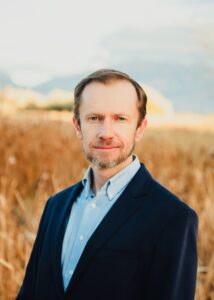
Peter McChesney is a dual Australian–U.S. citizen whose path has taken him from academia to corporate America—and now to storytelling.
A graduate in Communications from Western Sydney University, he also holds a bachelor’s degree in Law and Constitutional Studies and a master’s in Political Science, both from Utah State University—disciplines that shape the geopolitical and ethical dimensions of his fiction.
Before turning to novels, Peter taught U.S. history and political science but spent most of his career in software sales and real-world AI training. His debut novel, Quinto’s Challenge, begins a planned series exploring the ethical, societal, and existential implications of human resurrection.
To learn more about Peter, click either of the following links.
Elena Hartwell/Elena Taylor

Header image from Pixabay