The Guilty Sleep by Jeremy D. Baker
Book and Author Info + An Excerpt!
Don’t miss any book spotlights! Click the link here.
The Guilty Sleep
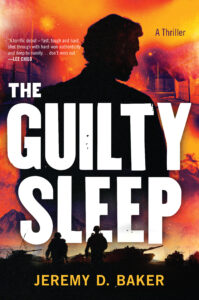 “A terrific debut–fast, tough and hard, shot through with hard-won authenticity and deep humanity. . . . Don’t miss out.”
—Lee Child
No one gets hurt is a fine plan. A worthy goal. But when it comes down to the moment, there’s always plenty of hurt to go around.
Afghanistan vet Dexter Grant is broke, reeling from PTSD, and on the verge of divorce when he’s approached by his old Army buddies to help rescue their former interpreter, the man who once saved Dex’s life. It means ripping off a vicious queenpin’s drug proceeds—but not to worry, they have it all worked out. And if anyone can pull it off, it’s Dex’s former team lead, Staff Sergeant Saenz.
Tempted by an easy score that could make his own problems disappear and imbued with new purpose, Dex agrees to play his part. But just as in combat, the best-laid plans don’t survive first contact with the enemy. When the heist goes off the rails, Dex’s wife and daughter become targets for bloody revenge. Dex must face down his spiraling inner darkness and call on all his strength and training to save his girls. In his quest, he’ll learn there was much more to this heist than he ever imagined.
Jeremy D. Baker bursts onto the crime fiction scene with this debut thriller that recalls C.J. Box’s unlikely hero Joe Pickett and the small-town, lived-in noir of S.A. Cosby. The Guilty Sleep is a riveting tale of robbery and betrayal in which a father’s love faces off with a soldier’s debt.
To purchase The Guilty Sleep click any of the following links: Amazon, B&N & BookShop
Read an excerpt of The Guilty Sleep:
Two Thirds of a Half-Bad Song
Dex
A couple of stools were open at the end of the bar. Prime real estate, but it was under the television. On screen, a blonde in a jewel-tone dress and a guy with massive, shellacked hair were having an animated conversation. The chyron read “Afghanistan Retreat Disaster.”
“Hey Dex,” said Tempest. “Usual for you?” She was the weeknight bartender. Cool as anything, all tattoos and piercings and distant affect. Polite and efficient, but God help anyone who pressed their luck. No way her name was really Tempest—probably Lisa or Jennifer or something—but he respected her vibe enough not to ask.
“Sounds good.”
Behind Tempest, the wall was a long mirror fronted by glass shelves of bottles lined up in soldier-neat ranks. He scanned the reflection. A practice ingrained from his days in Army counterintelligence training at Fort Huachuca, he could no more turn it off than he could still his own pulse. If you’re not facing the door, you need to be able to keep tabs on your surroundings. He skimmed past his own face: pale, two days’ growth, crosshatched scar above his left eye half-concealed by too-long hair. There was a couple at a high top near the front window, but they’d picked the one that was partially obscured, and they were both angled so they could see the door. He had a ring on, she didn’t. A late afternoon sneak-away. Other end of the bar, a UPS driver sipped an end-of-shift beer. Between the driver and Dex, three elderly drunks nursed inveterate highballs and traded susurrant murmurs. In the back room, a mismatched quartet of guys was shooting pool at the single table. Place was quiet, but it would pick up once the sun went down.
“Start a tab?” Tempest half-asked, setting the glasses in front of him with a professional smile. She already knew the answer. He nodded in thanks and sipped his bourbon. Once she turned away, he swallowed half of it, holding the burn in the back of his throat until he couldn’t take it anymore, then followed it up with a sip of the lager. The usual: one bourbon, one beer. Like a blues song, and not one of the good ones.
His eyes flicked to the television, and by the act of looking at it, the volume fell into place and he could hear what the jewel-tone dress lady and bouffanted dude were saying.
“Isn’t this a huge indictment of the administration’s foreign policy, Jarrett?” the woman asked, her voice sopping with scripted credulity.
“Absolutely, Ashleigh,” the high-haired chump responded. “A complete disgrace, if you ask me.”
“Well don’t just take our word for it, folks,” Ashleigh said, turning to face the camera and crossing her legs. “Stay tuned for retired U.S. Army Major Curt Slicker, who’s going to break it all down for us.” The screen split, showing a puffy, red-cheeked guy with a wispy buzz cut glowering at the camera.
“We’ll be…right back,” Jarrett intoned.
Dex nearly threw his tumbler at the television, but instead he downed the rest of the bourbon and thumped the empty glass on the bar. If he’d stopped there, at the one beer and the one bourbon, two thirds of a half-bad song, what came next would have shaken out into a typical week. Go to work, go to the bar, go home, try to sleep, nightmares, go on a long run, text his wife, try to see his kid, hate his own reflection, rinse and repeat. But, as Ol’ Dirty Le Batard had once said back in K-town, “If wishes and ifs were dried shrimp and grits, I’d have myself a fine-ass brunch.”
He caught Tempest’s dry-ice gaze and she drifted over for a refill. The hour melted into the next. Sip, swallow, repeat. Avoid the TV. The guys from the pool table crowded up next to him, squeezing around one stool that had remained miraculously empty. They hooted at Tempest, which was a strike against them, and they hollered at the next batch of airbrushed jack-wagons on the television, which would have balanced it out except the things they were saying were even more insipid than the bobbleheads of the small screen commentariat.
Dex finished the third bourbon and turned his fuzzed attention to the quartet. Put on his CI hat and studied them in the mirror across the counter. An odd set. The loudest mouth of the bunch was wearing shiny suit pants, a fitted white dress shirt, and a narrow tie. His hair was hard and slick-looking. Another, a guy with a bull’s neck and a beard that flowed over his chest like a bib, was wearing work pants with oil stains at the knees. The third was in ripped jeans and a black t-shirt for a hardcore band, and looked like he subsisted on Mountain Dew and cigarettes. The last guy was right out of a commercial for a mattress store, khaki pants and white sneakers, polo shirt tucked in tight around a spreading paunch.
Dex couldn’t make them fit at first, but they were a set for sure. Lots of laughing and clapping each other on the back, finishing each other’s sentences. Inside jokes and innuendos. He landed on former high school teammates. Football. They had an easy camaraderie, the kind that would hold on for a decade after graduation as life took them in different directions. Probably got together once a month to slam beers and reminisce. Linebacking crew, maybe.
“Put us on a plane and we’ll clean ‘at mess up right quick,” said the biggest guy, the one with the stained knees and beard.
“ARs and a few grenades, some-a-them rocket launchers,” put in the metal fan, his voice rattling with a speed un-slurred by the Natty Bohs he’d been chugging.
“Buncha primitive monkeys,” muttered the one who looked like he managed a mattress store. His eyebrows made a knot of anger at the bridge of his nose.
“You want to keep it down a bit?” asked Tempest, delivering their boilermakers.
“It don’t piss you off, sweetheart?” asked the businessman in the tight shirt, nodding at the TV. It was replaying images of Taliban technicals swarming the streets of Kabul, interspersed with chaotic evacuation scenes at the airport. “We cut and run an’ let those raghead camel-humpers take over? Makes us look like a bunch of cowards.”
“What’ll piss me off is if you guys break another glass.”
“Said I was sorry, hon,” said Metalhead. “It slipped.”
“G’head and start us another round, ok?” said Big Beard. “Put it on his tab.” He jerked his head at Businessman, who mouthed something unpleasant at his friend, smiling all the while.
“Ah, just look at them,” Mattress Guy grumbled, still staring at the screen.
“I think,” said Businessman, “we went too easy. Only way to go is scorched earth.” His three pals chorused agreement. “Do ‘em up like Connery said in that movie. ‘They pull a knife, you pull a gun. They put one of your guys in the hospital, you put one of theirs in the morgue.’ Like that.”
“Yeah,” said Big Beard. “They set up an IED, we nuke their ass. Glass parking lot. Scorched earth, like you said. Shoulda wiped out every one a them sand nig—”
“Excuse me,” Dex said.
A Frank Exchange of Views
Dex
“What’s up, bruh?” asked Businessman. The leader of the group. Probably the defensive captain. Still in good shape: tall and lean, but broad across the shoulders and thighs. Middle linebacker for sure.
“Just wanted to thank you guys for your service,” Dex replied.
“What?” said Metalhead, his face slack.
“You got all these expert takes, I figure you did some time in the sandbox,” Dex said. “So…you know…thank you for your bravery and sacrifice and all that. Shame the administration hasn’t retained you as consultants.”
“You tryin’ to be funny?” Big Beard asked.
“Hey,” said Tempest, her voice low and urgent.
Dex waved at her gently but kept his eyes on the group. His body followed his mouth, betraying the desire to slouch on his stool and drink until the night was hazy around the edges. He slid to his feet.
“What’s funny,” Dex asked, “about a humble private citizen wanting to buy a round for a group of such…distinguished war heroes?”
In addition to being the leader, Businessman was clearly the smartest—or soberest—of the group. “This guy,” he said, looking over his shoulder at his buddies, “thinks we ought to shut up about Afghanistan because we weren’t there.”
“What, and you were?” sneered Big Beard.
“Who says I was?” said Dex, same time as Tempest said, “Why doesn’t everyone just chill?”
“Ah,” said Businessman. His eyes drifted to the faint X of scars above Dex’s left eye, then down to the inside of Dex’s left forearm, where the unit crest—raven in profile sinister on mantled shield, 296 MI BN stamped above, BLACKBIRDS scripted below—took up a wide swath of skin. Dex fought the urge to tug his sleeve down. “Ah,” said Businessman again, drawing it out to three syllables.
“No way,” said Metalhead. “This skinny-ass hipster?”
“So, you’re qualified to talk about it and the rest of us should shut up?” said Mattress Guy.
“No and yes,” said Dex. “In that order, in case you weren’t following—don’t strain your brainpans.” He couldn’t stop. There was a smell in the air, might have been ozone. “I can ask Tempest for a box of crayons and construction paper if you think it would help. Make you a little presentation for clarity.”
“Wait, what?” This from Metalhead, clearly the driest marker in the pack.
Dex sniffed, scenting like a hound. “You smell that? This guy’s cerebellum just started smoking.”
“This prick thinks he’s better’n us, fellas,” Businessman said. “Just ‘cause he was over there.”
“No,” said Dex, whispering through his teeth, “I’m no better than you. I’m worse, if such a thing is remotely conceivable. And you doorknobs look about as collectively beneficial to society as an unsalted pretzel.”
Mattress Guy snarled a curse under his breath and cracked his neck.
“Gentlemen,” Dex said, rolling his shoulders and spreading his hands wide in faux apology, “if I’ve said anything to offend you, I can assure you it was completely intentional.”
“Y’ask me,” grunted Businessman, “losers like you are why things look like that right now.” He waved at the screen, which showed a frantic woman trying to pass a little girl over the barbed wire fence that ringed the airport.
“Be back to settle up in five, Tempest,” Dex said, and shouldered his way through the foursome. He reached the door and looked back. “You guys coming? Don’t keep me waiting, I’ll get all lonely.”
Businessman slammed his glass down, sloshing his drink across the bar. “Let’s go boys, this guy needs his ass beat.”
“Thought you were never gonna take the hint,” Dex said. He stepped out into the night.
The football team followed thirty seconds later, walking like they’d done this before. Surely they had. Dex scrolled back through a dozen fights, realizing belatedly just how stupid this was. He’d never, even on his wildest day, been dumb enough to take on four guys.
“Oh man, we are gonna kick the shit out of you,” said Big Beard.
The four chuckleheads formed themselves into a semi-circle, from left to right: Metalhead, Businessman, Big Beard, Mattress Guy.
Before Afghanistan, during his first combat tour in northern Iraq teaching the Kurds to interrogate people without using a car battery and kiddie pool full of water, Dex’d been teamed with a Romanian corporal who’d trained as a cage fighter for fun. Thickset guy with hands like ham hocks and a dry sense of humor. He used to spar with Dex at the base gym. The Romanian would never touch gloves; he’d just explode into attack mode right from the jump. He told Dex he didn’t believe in wasting time with niceties. When you’re there to touch gloves and smile, touch gloves and smile. When you’re there to talk, talk. When you’re there to fight, bloody fight.
Dex figured two things: he’d done enough talking, and Big Beard was the most dangerous member of the group. Looked like he could take a sledgehammer to the gut and shrug it off. The rest of the crew probably figured Dex would want no part of him. Metalhead and Mattress Guy each took a shuffling step forward. Any second, they’d move in, either driving him back or pinning him for Businessman and Big Beard.
Dex danced forward, grabbed a fistful of Big Beard’s big beard with each hand, and yanked the guy’s face down as hard as he could. Same time, he pistoned his knee into Big Beard’s chin. The guy snapped straight back and kept going. His feet went slapstick high, and he slammed into the parking lot on his back, legs dropping like a pair of felled timbers.
Dex spread his fingers. A dusting of wiry hair drifted down, and he blew it in Mattress Guy’s face, laughing. He whipped toward Businessman, planning a right into the guy’s face and then a spinning elbow strike into the side of Metalhead’s…well…head. Then he could take his time with pudgy Mattress Guy, who was clearly the lowest threat of the bunch. It was a perfect mental choreograph and he was already flowing into it when Mattress Guy ruined everything by being, in fact, the highest threat of the bunch. Businessman was still gaping at Big Beard’s prone form, Metalhead was beginning to shout something (probably “Wait, what?”), and Dex was winding up for a beautiful cross into Businessman’s jaw when Mattress Guy flowed like water and planted a hard left into Dex’s side. He staggered and Mattress Guy grabbed Dex around the waist and dumped him to the ground.
Businessman and Metalhead crowded in. Mattress Guy rained blows at Dex’s head and Dex mostly took them on the forearms, but one caught him a glancing swipe on the ear and his head rang with the hot sting of it. Dex got a hand around Mattress Guy’s heel and twisted, rolling them over. Now on top, Dex sent a left-right combo into the guy’s double chins, but then the other two were dragging him off.
Businessman threw a sharp left into Dex’s cheek, snapping his head back. “Hold still and take what you got coming,” he snarled. Metalhead seized Dex’s arms, pinning them behind his back.
Dex felt a trail of blood flow over his upper lip, tasted it with the tip of his tongue. And then Mattress Guy was on his feet, pushing Businessman aside. He worked Dex’s chest and midsection like a heavy bag. Metalhead whooped, which was at least better than “Wait, what?”
Three, four heavy punches to the body. Mattress Guy grinned at Dex and Dex found himself grinning back into the guy’s face. The pain wasn’t real yet—that would come later—but the promise of it was there, thick and rich as each blow landed.
“What—are you—so—happy—about?” Mattress Guy grunted, winded from the effort.
“When—are you—gonna—really—hit me?” Dex gasped, but what he meant was Keep it coming. This is what I deserve. The smell of ozone had become the lightning strike, and the thunder was right behind. The black river waited.
“Switch out,” said Businessman, and Mattress Guy gave a grateful nod and grabbed Dex’s arm as Dex sagged against him. Businessman stepped in front of Dex and started rolling his sleeves up his forearms. “My boy worked the body, but I think I’ll rearrange your pretty face some more, what do you think about that?”
There was a flare of light from the main road, headlights across rain-slicked pavement. The shadows behind Businessman coalesced and suddenly the guy disappeared in a gray billowing cloud. There was a hollow thump and Dex blinked and Businessman was crumpled on the ground, unmoving. There was someone standing where the guy had been, haloed by the streetlights and traffic. Fair hair and a long gray raincoat.
“Wait, what?” mumbled Metalhead.
“You ever say anything else?” Dex groaned, and whipped his head back as hard as he could, smacking into Metalhead’s face with a satisfying thump.
Metalhead let him go with a screech, and Mattress Guy stepped to the side. Dex slumped to his knees. There was a snick and a gleam in the reflected light and suddenly Mattress Guy was holding a carpet knife, blade pointed toward the new guy. There was a rustle and the sound of metal on leather and the new guy had a pistol, angled out and away from his body so its outline would be clearly visible.
“Hey man,” Metalhead said, holding his streaming nose.
“Uh,” said Mattress Guy, dropping the knife and putting his hands up.
“Go away,” the silhouette said in a harsh whisper. “Come back for your friends in five minutes.”
The two scampered, cutting a wide berth around Raincoat Guy, who stepped forward and held out his hand. The gun was gone. Dex looked up and the man’s face came into focus.
“Sarnt Saenz,” he managed. “Long time no see.”
Saenz waved his hand in front of Dex’s face. In the shadows, his expression was unreadable. “Come on, Frogger. On your feet.”
“I hate that nickname, Sarnt.”
Tête-à-Tête/We Need to Talk About Jalal
Saenz
“I need your help.”
They were sitting at the wobbly kitchen table in Frogger’s crappy apartment, having just completed the timeless ritual of a seasoned NCO trying to get one of his troops to sober up and focus.
“For what?”
Saenz took a beat. Let the silence do the work, build the connective tissue to Frogger’s interest. Kept his tone firm, sincere.
“To save Jalal Hamidzai’s life.”
“Say again?”
“Jalal,” Saenz repeated. “His family too. I need your help.”
Saenz watched Frogger start to put the pieces together. Jalal had been one of their interpreters in Kandahar. A great one. He would’ve been high on the Taliban payback list for that alone. And if word had gotten out about what he’d done during the incident at the compound, he’d be in their top ten.
“What happened?”
“Yeah, I started at a bad place,” Saenz said. “I was going for dramatic effect to get your attention.”
“It worked. You have it. But how about reframing the scenario for me?”
“Listen to you. ‘Reframing the scenario.’ You really did pay attention.”
“You made us smarter. Better. So, help me understand the problem.”
“Fair enough,” Saenz said, holding up his hands in mock surrender. He laid out the tale carefully. Setting the stage for Frogger’s eventual capitulation, piece by microscopic piece. It was a masterwork, equal parts horror, Kafka-esque bureaucratic nightmare, and tragedy. And like all deception ops, it was a perfect blend of lies and truth.
After what happened at the compound, it was all over for their team in Afghanistan. But Jalal decided to stay in Afghanistan. Keep fighting the fight. Moved his family out of K-town and up to the capital and, with Saenz as a reference, landed as a terp at the embassy in Kabul. Another two and a half years of service to the U.S. flag, knowing there was a new life for him and his family on the other end.
When the Americans decided to pull out, Jalal—always savvy as a vacuum cleaner salesman at a dust convention—read the chay leaves. He was a target, and his family would be greenlit as well. Accordingly, he was first in line for an SIV, the promised benefit for Afghans who’d helped the U.S. during the war.
Only there was a problem with the Special Immigrant Visa. A hiccup. The State Department factotum reviewing Jalal’s bona fides noted a troubling relation. A second cousin by marriage to an individual of concern, Kamaluddin Haqqani, the youngest son of Sirajuddin Haqqani. And even though Jalal himself had disclosed the relationship on his background forms when he first applied to work with the Americans, it was suddenly enough derog to kibosh the issuance of the SIV. A connection to the infamous and sprawling Haqqani Network—half mafia, half terrorist, all bad juju—even one as tenuous as Jalal’s, was a no-go for State. It painted unpleasant pictures: a family of sleeper agents burrowing into American society, waiting for activation. Suicide bombings. School shootings. Poisoned reservoirs. Sniper attacks. A nightmare on home soil, one we invited in ourselves? Thank you for your service, but no thank you.
All nonsense, of course. Jalal had proven himself loyal a dozen times over, but especially at the compound. He should have been given a medal and a first-class flight to the States. When he’d exhausted the appeals process, working his way through the bureaucratic chain and getting a no all the way up to the chief of staff to the ambassador himself, who relayed yet another no (at least this time with regrets), Jalal reached out to Saenz.
And Saenz, in his capacity as the finest counterintelligence mind in a generation and rising junior partner at the military-adjacent contracting multinational Golden Oak, broke open his considerable toolbox. He reached out to every military, paramilitary, and contract partner in the company portfolio, going off-books when needed, making promises he’d never be able to keep. Might cost him his job when everything unraveled, he said with a gentle shrug calculated to the razor’s edge of fatalistic acceptance. Next, he leveraged the network of sources, informants, and officials in Afghanistan he and Jalal had built in country. Pulled every thread, called in every favor, read everyone the same chay leaves.
Upshot was, he arranged for Jalal and his family to travel north by jingle truck from Kabul to Mazar-i-Sharif, then across the border into Uzbekistan. Along the old silk road to Samarkand, then a series of decreasingly rickety airframes to Baku, Ankara, Addis Ababa, and Nairobi. There, Jalal and the family boarded a cross-continental flight to Dakar. Six hours after landing, they were on the Panamanian-flagged cargo ship Antares, bound for the Americas. Two days later, Kabul fell. Couldn’t have cut it any closer.
“Ship docks at the Port of Baltimore on Saturday,” Saenz said, draining the last of his coffee. He stood and stretched, cracking his back. Poured a fresh cup. He raised the pot and his eyebrows. Frogger nodded. Saenz topped him up and set the pot back on the burner. It gave off a soft hiss.
“You’ve been busy.”
“You’re telling me,” Saenz chuckled. “Had all my hair last month.”
“I understand that. You’ve basically coordinated an international human smuggling operation.”
Saenz gave him an interrogator’s stare, and it was Frogger’s turn to put up his hands. “Not saying it was wrong. State should have processed the SIV and put him and his family on a private jet out of Hamid Karzai International.”
“We agree.”
“You did the right thing.”
“We agree,” Saenz repeated.
“It also sounds like you have things under control. You were the best op planner I ever served under.”
Saenz fed him a grateful smile, then said, “But, you wanna ask me, if it’s going so well, why am I reaching out?”
Dex nodded and sipped his coffee.
“Hit a snag. Bad one.”
“I’m listening.”
“Ok, Jalal’s on the boat—”
“—the Antares—”
“Right. Due in on Saturday. With his family.”
“How many?”
“Four others. His oldest son, just turned nineteen. Younger son, seventeen, I think.” That much was true. And now another lie: “His wife and their little girl, too. She’s, like, five? A little older than your daughter.”
“Full house. Or shipping container, I’m assuming.”
Saenz tapped the tip of his nose. “In one.”
“The snag?”
“World runs on money, Dex.”
“As they say.”
“And I ran out. Played fast and loose with the Golden Oaks books, changed up some contract terms, and called in those favors in-country to move a few suitcases of dinars, rupees, and afghanis around. Hell, I wiped out my own personal savings, cashed in my 401k, everything.”
“Not enough?”
“It was. That’s the problem. My guy in Nairobi called.”
“Not a good sign.”
“The worst,” Saenz said, nodding. “He said we have to pay a skinner fee on arrival.”
“Skinner fee?”
“COD payout. To the port director in Baltimore.”
“Ah,” Frogger said. “I’ve heard of those guys. They run security at the cargo ports, right?”
“Exactly,” Saenz said, and doled out the rest of the breadcrumbs. “And the Baltimore bubba is bent—main reason I chose the place.”
“Home turf doesn’t hurt,” Frogger added, and Saenz nodded because he saw the wheels turning, and it would be better if Frogger worked the next part out himself. “And your Nairobi coordinator told you the port boss changed the terms on you?”
Saenz allowed a proud-papa smile. “Got it in one again.”
“Let me guess, he raised the price because it was Afghans. Like an import duty. I read a thing, said Mexican smuggling groups do the same when they move South Asians and Middle Easterners over the Texas border.”
“That’s it.”
“Shoot, your guy in Nairobi’s probably the one who gave the port boss the heads up.”
“Cynical—big surprise—but you’re righter than you know. This port director is the law enforcement and inspection chief, head bureaucrat, and senior oversight presence for Uncle Sam, all rolled into one. Responsible for everything that comes in and out, and he’s got a couple dozen badge-and-gun toters crawling all over the port on any given day. Basically, dictator-god-for-life. Gatekeeper for all cargo, licit and illicit, moving through the port. Drugs and money coming in; cars, guns, and money going out.”
“People.”
“Say again?”
“And people. Coming in,” Frogger said.
“Uh-huh. And the port director doubled his rate.”
“Call me cynical again, but I would have expected that, Sarnt.”
Saenz sighed heavily. Ran his hands through his hair again. Rubbed his face. Let himself look defeated. “I did,” he said, after a long pause. “But I hoped for the best, that I’d have time to pull more cash together just in case. I was wrong.”
“And if he waits until your precious cargo is halfway across the Atlantic, you can’t exactly pull out of the deal while they extract the rest of the blood from the stone.”
Saenz nodded, letting his face go hard.
“Only problem is,” Frogger continued, following the last of the breadcrumbs, “if I’m hearing you right, there’s no blood left in the collective stones.”
“Exactly.”
“And you’re hoping I can help.”
“I know you, Fro—Grant. You were always one of the good troops. Stand-up guy, wanted to serve his country, do the right thing. That…thing at the compound hosed you up.” Saenz cast a look around the dim kitchen. “Got you twisted so much when we got back to the world you didn’t know your head from your fourth point of contact. Missing duty weekends. Or showing up smelling like a bottle. Taking a swing at the CO.” Frogger’s eyes flicked up for a second, caught his own, then sheared away. Saenz thought he’d gone right up to the line, so he pulled back, softened his voice with an injection of sympathy. “I get it. I disagreed with the OTH discharge—I would’ve tried to get you right—but Battalion made the call, not me. I say there’s no shame in it. The thing that happened…it messed with all of us.”
“Where you going with this, Stu?”
“You’re still the guy who wants to do the right thing. I can see it. And you know as well as I do Jalal saved us. Any of us who made it through that day, it was because of him. And if we don’t come up with two hundred forty thousand dollars, the port director’s going to call the captain of the cargo ship and have him slit Jalal’s throat and throw him overboard. His sons, too. Probably give the crew the wife and daughter as payment,” Saenz finished, disgust coloring his tone.
Frogger stared at him. Saenz saw him focus inward, like he was studying his own breathing. In and out. Slow. Trying to take in the enormity of it. He was almost there. Right on the precipice, ready to take the leap. Saenz focused on his own breathing, subtly matching Dex’s. Amazing how after all these years in the game, the approach to closing the deal still got his blood up. What a rush.
Frogger straightened.
“I’d like to help. It’s righteous, and God knows I’m trying to do right these days. But look around you, man,” Frogger said, spreading his arms to take in the kitchen, dimly lit by the stuttering fluorescents; the wobbly table, the mismatched chairs, the battered fridge. Then he pointed at his own battered face. “I look like I’m in any position to help?” He laughed bitterly. “I have nothing. My wife kicked me out. Filed for divorce and primary custody. I’m not making a hundred grand a year at Booz Allen or Golden Oak like you—got a mountain of bills crushing my spine instead. Top of that, I drink too much. Shit, I sold my beater so I wouldn’t end up with a DUI. I have nothing,” he repeated. “I’m no help to anyone right now.”
“It doesn’t have to be that way,” Saenz said.
“What?”
Saenz paused, hands wrapped around the coffee mug. He looked up, his eyes boring into Frogger’s own. Time to land him.
“You still work at the bank?”
More about Jeremy D. Baker: Jeremy D. Baker grew up in Italy, Florida, and Maryland. He’s a former US Army counterintelligence agent and combat veteran. He served alongside US Special Forces in Afghanistan and is a PTSD survivor. Over the past 20 years, his work in national security has focused on intelligence, counterterrorism, transnational organized crime, human trafficking, climate risk and resilience, and cybersecurity. He lives with his family in Maryland. Read more at https://www.jeremydbaker.com/.
*** Excerpt from The Guilty Sleep by Jeremy D. Baker. Copyright 2025 by Jeremy D. Baker. Reproduced with permission from Jeremy D. Baker. All rights reserved.
Author of The Guilty Sleep Jeremy D. Baker
 Jeremy D. Baker grew up in Italy, Florida, and Maryland.
He’s a former US Army counterintelligence agent and combat veteran. Like Dexter Grant, he served alongside US Special Forces in Afghanistan.
Also like Dexter, he’s a PTSD survivor.
Over the last 20 years, his work in national security has focused on intelligence, counterterrorism, transnational organized crime, human trafficking, climate risk and resilience, and cybersecurity. He lives with his family in Maryland.
Learn more about Jeremy by clicking any of the following links: BlueSky, Twitter & Instagram
Elena Hartwell/Elena Taylor